
How Much Does China CNC Turning Cost in 2026? A Buyer's Cost Model for Turned Parts
Most buyers price the wrong unit when they quote a turned part. A shaft, a bushing, or a fitting looks like one line on a BOM, so it gets priced like one line, and the number that comes back is almost useless. A turning quote is really a route across a machine: the bar it starts from, the machine class that holds its length, the features cut into it, and the tolerance that decides how it is measured. Read that route once and you can budget the whole part family, compare Chinese suppliers on the same basis, and stop treating every new turned print as a fresh leap into the dark. This guide is that cost model for 2026: the line items inside a China CNC turning quote, what moves each line, and how to compare quotes fairly.
What does a China CNC turning quote actually pay for?
Strip the formatting off any honest turning quote and the same lines appear underneath. Each has a job, and each can hide a cost if the shop does not name it.
| Line item | What it pays for | What moves it |
|---|---|---|
| Bar stock | Ground or drawn bar at the grade and diameter on the drawing | Alloy, bar diameter, and whether the lot is certified and verified |
| Machining time | Spindle minutes to remove stock and hold the diameters | Length-to-diameter ratio, feature count, and material machinability |
| Setup and programming | Guide bushing or chuck setup, tooling layout, first-piece prove-out | A fixed cost per order; heavier on Swiss-type and first-time parts |
| Secondary operations | Threading, cross-drilling, milling flats, knurling | Each feature beyond pure turning adds a tool or an operation |
| Grinding | The ±0.002 mm bands turning cannot hold | A separate process family with its own machine and measurement |
| Finishing and inspection | Passivation, plating, anodizing, CMM reports, certificates | Every tight diameter and surface callout adds measurement time |
There is no honest single number for China CNC turning, because the drawing and the bar decide it together. What stays consistent is the structure, and the structure is what makes a turning quote readable, comparable, and auditable.
How does the length-to-diameter ratio decide the price?
The first cost question on any round part is which machine class it belongs on. A short, stubby part — length under roughly three times its diameter — runs on a conventional CNC lathe, where the hourly rate is lower and the setup is simpler. As the ratio climbs to five, ten, or twenty diameters, a conventional lathe starts fighting deflection and chatter, and the part belongs on a Swiss-type turning machine where a guide bushing supports the bar right at the cutting point.
That machine decision is the largest single driver in a China CNC turning quote, because the two machine classes have different rates and different cycle economics. A slender shaft that would chatter on a conventional lathe holds its tolerance on a Swiss machine, but the Swiss cycle is slower and the setup, with guide bushing sizing and tool layout, is more involved. The comparison that matters is not the hourly rate but the cost per good part: on a slender part, the Swiss machine makes it right the first time, which is cheaper than making it wrong on the cheaper machine.
The buyer rule is simple. Confirm which machine class the drawing needs before you compare totals, and ask the supplier to name it — "this runs on our Swiss line" is a routed quote; "we can make it" is a hope. A part that can run conventionally should be quoted conventionally; a part that will deflect belongs on the Swiss machine, and the price should say so.
How much does material choice move the price?
Material affects a turning quote twice: once in the price of the bar, and again in how slowly the machine must cut it. Free-machining grades are cheap to buy and cheap to turn; tough grades are expensive in both directions.
| Material | Machinability | Typical cost vs 6061-T6 (bar) | What buyers use it for |
|---|---|---|---|
| 6061-T6 aluminum | Excellent | Baseline | Bushings, spacers, light hardware |
| 2024 / 7075 aluminum | Good | Roughly 2–3× | Higher-strength turned hardware |
| Brass (C36000) | Excellent | Roughly 3–5× | Fittings, valve components, electrical parts |
| 12L14 steel | Very good | Roughly 1.5–2× | Fasteners, general turned steel parts |
| 303 stainless | Very good | Roughly 2–3× | Fasteners and corrosion-resistant hardware |
| 304 / 316L stainless | Moderate | Roughly 2–4× | Corrosion-resistant fittings and components |
| 17-4PH stainless | Moderate | Roughly 3–5× | High-strength parts that resist corrosion |
| Ti-6Al-4V | Difficult | Roughly 6–10× or more | Aerospace, medical, weight-critical parts |
These multipliers are budgeting heuristics, not quotes — actual pricing follows the exact grade, bar diameter, and quantity — but they explain the shape of the market. A material decision can move a turning quote by a factor of two to five before tolerance and finishing are even added. The aluminum versus stainless trade is common enough that it has its own decision guide; when you are weighing the two for a turned part, the aluminum vs stainless decision guide works through the full comparison.
Which features push a turned part's cost up?
On a turned part, cost concentrates in the features that fight the machine. Each of these adds a tool, an operation, or a slower pass:
- Long, small-diameter sections. Slenderness forces a Swiss-type machine or a slower, more careful cycle.
- Threads. A thread is an operation with its own tool and its own inspection; rolled threads on high volumes are a different, more economical process than cut threads on small runs.
- Cross-holes and milled flats. A feature that is not round pulls the part into mill-turn territory or a second operation.
- Undercuts and grooves. Each groove width and depth needs a tool that can reach it; non-standard widths force a custom form tool.
- Tight internal bores. A deep, small-diameter bore needs a boring bar that does not chatter, which limits depth relative to diameter.
- Tight tolerance on many diameters. Every controlled diameter adds measurement and often a finishing pass.
None of these is a reason to avoid a turned part — they are reasons to review the drawing. A design-for-manufacturing pass that catches them while the file is still editable is the cheapest cost control a buyer can buy, because every feature fixed before release is a feature the quote no longer prices as a risk. The parts overview on this site lists the turned part families a shop of this kind runs, which is a useful reference for what a normal turned drawing looks like.
How much do tolerance and surface finish add to the quote?
Machining cost is nonlinear in tolerance. Moving a diameter from a general ±0.1 mm to ±0.003 mm does not cost a little more; it can more than double the cost of that feature, because the cutting strategy, the finishing pass, and the inspection method all change at once. On a turning floor, the realistic production envelope is ±0.003 mm for turned diameters, with precision grinding reaching ±0.002 mm for sealing seats, bearing journals, and roundness-critical features. Process capability is tracked at Ppk ≥ 1.67 at the initial study on key characteristics and Cpk ≥ 1.33 on general characteristics. Capability is reported per characteristic: every report names the feature, its tolerance band, the sample size, the sigma method, and the study window., which is the statistical statement that parts sit inside the band with margin rather than at its edge.
Surface finish adds a smaller but real line. Ra 1.6 µm is routine as-turned; Ra 0.8 µm on a diameter takes a finishing pass; a specified Ra 0.4 µm or better usually implies grinding. Each step down the roughness scale adds machine time and inspection. If you specify an impossible finish everywhere, you are paying for it everywhere, and the same discipline that keeps the tolerance band small keeps the finish callouts honest: name the Ra where the surface seals, bears, or rotates, and leave the rest on a standard turned finish.
The buyer rule is to call tight tolerance and fine finish only on the features that earn them. A bearing seat at ±0.002 mm and a seal diameter at Ra 0.8 are legitimate; the same numbers scattered across every shoulder and face are a design tax. A shop that reads the drawing and says "two features need the tight band, the rest can ride the general block" is doing the buyer's cost engineering for free, and the quote should reflect it.
How does quantity bend the unit price?
The setup is the same whether you order one bushing or a thousand: the chuck or guide bushing, the tooling layout, the program, and the first-piece prove-out cost the same either way. At one piece that fixed cost lands entirely on the part, which is why a prototype looks expensive. As quantity rises, the setup spreads across the run and the unit price falls toward the sum of bar and machining time.
For a turned part the curve has a second bend around the quantity where the process changes. A small batch of bushings might run on a conventional lathe; a very large batch might move to a bar-fed machine that runs unattended, cutting the per-piece time. The supplier should name the process change at the quantity break, because it changes the economics honestly. And once a part is proven, the reorder skips the first-article step: the same part ships faster at a lower per-piece rate, because the setup is no longer a gamble.
The honest quote shows three stages on one page: a single piece at MOQ 1 on the same machines and tolerances as production, a bridge order of ten to fifty parts that exercises the setup before volume is committed, and the production tier where the fixed lines amortize. Budget all three at your real quantity, and the number will survive the first invoice.
Why does buying from China add freight to the real cost?
The turning quote is the factory gate; the landed cost is the number that should drive the buying decision. When you ask "how much does China CNC turning cost," the full answer includes the logistics leg from Dongguan to your door, usually routed through the ports of Shenzhen or Hong Kong. Turned metal parts are dense, so the freight line can rival the machining line on cheap, heavy parts.
Four planning moves keep logistics from eating the saving. First, choose the incoterm explicitly — EXW, FOB, and DDP move duty and freight risk differently, and DDP shifts the whole chain to the supplier. Second, fly prototypes and let production batches ride ocean freight; the per-piece freight difference between air and sea is large. Third, ask whether the supplier consolidates shipments — batching multiple buyers' goods onto one freight leg is common in the trade and cheaper than single-package courier shipping. Fourth, watch the schedule: machining lead time and shipping time are different commitments, and the supplier should state both. The turning lead-time guide separates the machining calendar from the freight leg.
What hidden costs sit inside a turning quote?
The visible lines are half the price; the other half hides in what the quote does not say. A quote that prices per piece but not per part number has hidden the setup you will pay again on the reorder. A quote that absorbs inspection into the margin has hidden the CMM report you will recreate at incoming. A quote that folds grinding into a vague "included" has not told you which feature is ground or at what band. A quote that prices one process and dates another has hidden the schedule risk. And a quote from a supplier that cannot name its machines, its metrology, or its certificate scope has hidden the verification entirely.
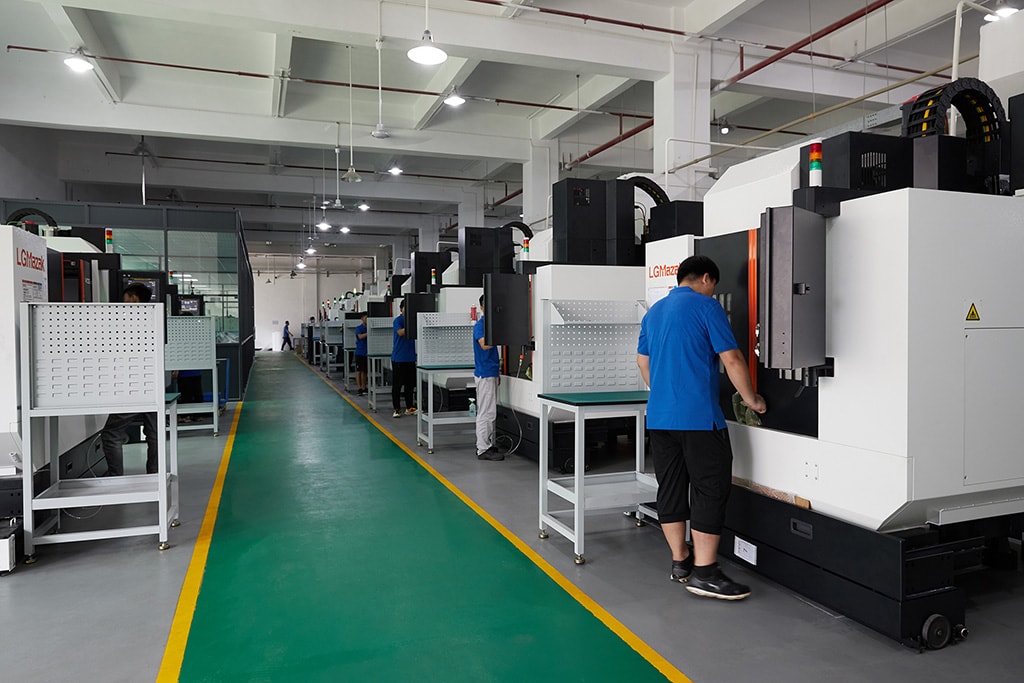
The supplier itself is the largest hidden cost of all. A trading desk adds a margin and removes accountability; a real turning shop answers with specifics — the machine list by type and bar-size range, a recent CMM report on a similar turned part, and the material verification method — because it has nothing to hide. The quality system behind this site is documented on the quality page, and the machine floor behind the quotes is on the factory page; both are the kind of evidence a buyer should collect from any candidate before comparing totals.
How do you get comparable turning quotes from Chinese suppliers?
Price differences between Chinese turning shops are real, but most quote-to-quote gaps are scope differences wearing the disguise of price. A quote that excludes grinding, or ships EXW while another ships DDP, is not cheaper — it is incomplete. Comparable quotes come from identical inputs:
- Same file set. A STEP or IGES 3D model plus a toleranced 2D drawing, sent to every supplier. PDF screenshots produce three different quotes for three different parts.
- Same material and bar callout. 6061-T6, 303, and 316L are different prices; name the grade and the bar diameter.
- Same quantity and incoterm. Unit price at qty 100 FOB Shenzhen is a different number than qty 1 DDP anywhere.
- Same finish and documentation scope. Include surface finish, plating or treatment, and whether a dimensional report or material certificate is required.
- Same response format. Ask each supplier to itemize bar, machining, finishing, inspection, and freight. The supplier that itemizes is the supplier you can audit.
Read the machine-class statement too. A quote that says "Swiss-type, bar-fed, one setup" is a routed quote for a slender part; a quote that names no machine class has not priced the geometry. The service range a single China turning supplier can route your part through is on the services overview, which is the frame for a comparable request.
Frequently Asked Questions
How much does China CNC turning cost in 2026?
No honest shop quotes a turned part without a drawing, because price is set by the bar diameter, material grade, part length, feature count, tolerance, and quantity. As a working budget, a simple small aluminum bushing at mid volume often lands between a few US dollars and roughly $10–15 per piece, while a complex stainless or titanium part with tight tolerances and low quantity can climb to $50–150 or more before finishing and freight.
Why does a longer turned part cost more per piece?
Length-to-diameter ratio drives the machining route. A short stubby part turns on a conventional lathe; a long slender shaft deflects and chatters unless it runs on a Swiss-type machine with a guide bushing. The longer and thinner the part, the more the process and the cycle time cost.
What moves a turning quote the most — material or machine time?
Machine time is usually the largest line, driven by how much bar must be removed and how many features the part has. Material comes second. A free-machining grade cuts fast; titanium and 316L cut slowly, so the same geometry can differ by a factor of two to five between alloys.
How much do tight tolerances add to a turned part?
A feature moved from a general ±0.1 mm to ±0.003 mm can more than double its cost because cutting strategy, finishing passes, and inspection all change. A ground feature at ±0.002 mm adds a separate grinding operation. Call tight tolerance only on diameters that mate, seal, or spin.
Does ordering more turned parts lower the unit price?
Yes, but only because setup, programming, and first-article cost spread across the run. Doubling quantity rarely halves the unit price; the curve flattens once the fixed lines are absorbed. Ask for the price at your actual quantity and the fixed-cost split.
Are there minimum order quantities for China CNC turning?
For this shop, one piece — prototypes run on the same machines and tolerances as production. Across the market, many suppliers accept low quantities but load the fixed setup onto the first pieces, so a one-off is priced differently from a thousand-piece run even when both are accepted.
How do I get comparable turning quotes from Chinese suppliers?
Send the same package to each: a STEP or IGES 3D model, a toleranced 2D drawing, the material grade and bar diameter, quantity, finish, and target incoterm. Ask each supplier to itemize material, machining, finishing, inspection, and freight separately, and compare only quotes that state the same scope.
Which bar diameter should I specify, and does it change the price?
Specify the smallest standard bar diameter the largest feature allows, because bar cost and machine time both follow stock size. A non-standard or oversized bar adds material cost and may force a different machine class. The shop can confirm which bar size its turning centers feed.
Want a China CNC turning quote you can read line by line?
Send the drawing, the material grade and bar diameter, and the quantity to [email protected] or call +86 13126536955. You will get a design-for-manufacturing review and an itemized quote — bar, machining, finishing, inspection, and freight separated — with the machine class named.